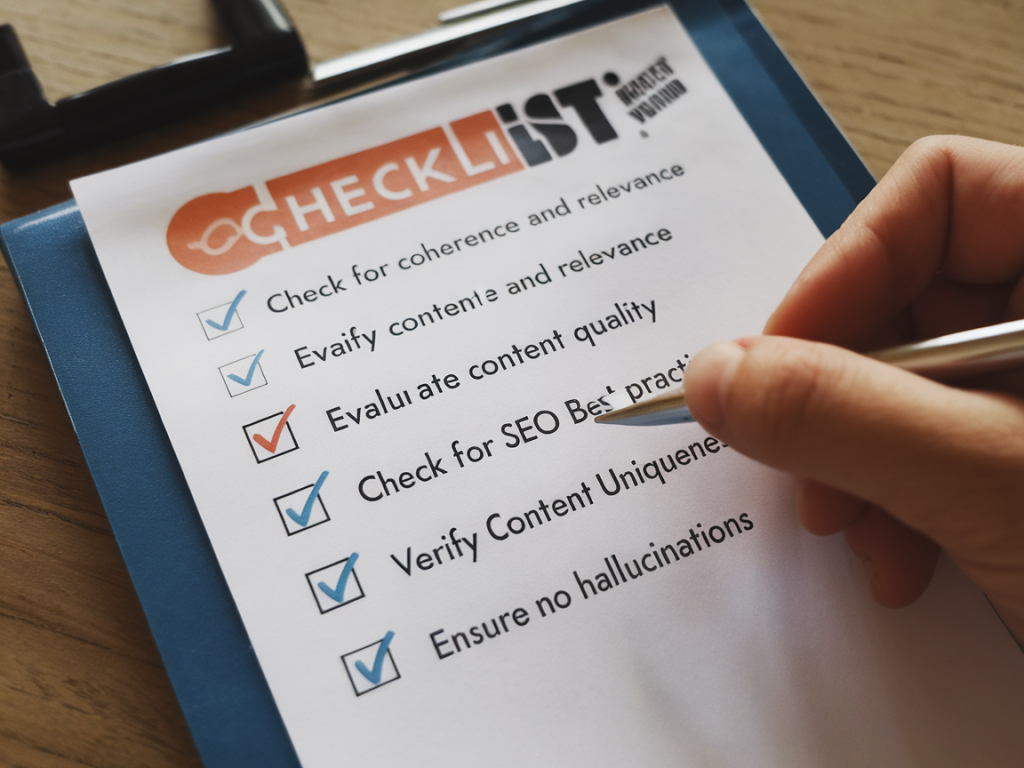
I use generative AI for marketing copy all the time — landing pages, social hooks, product descriptions — but I don’t trust it blindly. Left unchecked, AI can invent facts (hallucinate), introduce subtle SEO problems, or produce copy that reads well but won’t convert. Over the last couple of years I’ve refined a short, repeatable validation checklist that catches the usual failure modes without slowing down creative velocity. Here’s the 5-step approach I run every draft through before anything goes live.
Step: Check factual anchors first
Generative models are great at sounding confident. That’s also their biggest risk. My first action is to identify any factual claims the copy makes and verify them against authoritative sources before anything else. Treat these facts as non-negotiable anchors.
- Does the copy state product specs, dates, pricing, or certifications? Verify against the product sheet, pricing page, or internal brief.
- If the text mentions third-party integrations, partner names, or case study numbers, confirm with the partner team or a source link.
- For legal claims (e.g., “GDPR-compliant”, “FDA-approved”), ask legal or compliance to sign off.
Tools I lean on: a quick search of the brand’s official docs, an internal knowledge base (Confluence/Notion), or primary sources (product page, legal docs). If the model invents a statistic or attribution, delete or replace it with a verified figure and add a source link or a neutral phrasing like “based on internal data”.
Step: Surface and remove possible hallucinations
Hallucinations aren’t always dramatic — they can be subtle details that sound plausible. I scan for any invented proper nouns, made-up quotes, or speculative cause-effect lines. If it isn’t in a validated source, assume it’s suspect.
- Watch for precise-sounding but unsupported statements (“our customers see a 42% uplift”). If you can’t validate it, change to a safe alternative (“customers often see significant uplift” or cite a range from verified data).
- Check quotes and testimonials. If the AI generated a testimonial-like line, replace it with a real customer quote or label it as a hypothetical example.
- When in doubt, add hedging language or remove specifics altogether. Clear, honest copy beats a risky invented claim.
Pro tip: keep a running “red flags” list for phrases or constructs your team finds commonly hallucinated (e.g., invented tool names, fake research reports). Train prompts to avoid generating those patterns.
Step: Audit for SEO intent and technical signals
AI can write readable copy but still miss key SEO signals — intent alignment, keyword context, and snippet-readiness. I read through the draft with three SEO lenses: keyword prominence, search intent match, and snippet potential.
- Keyword prominence: Make sure your primary keyword appears in the H1 (or near the title), meta description, first 100 words, and naturally across the copy. Avoid keyword stuffing — let the phrasing be natural.
- Search intent: Does the copy answer what someone searching that query expects? If the intent is transactional (e.g., “buy noise-cancelling headphones”), the page should include pricing, benefits, and a CTA. If the intent is informational, include how-to steps, FAQs, and authoritative links.
- Snippet readiness: Add an explicit, concise summary or bullet list that a search engine could lift for a featured snippet. Use schema where possible (FAQ, Product, HowTo).
I use tools like Ahrefs or Semrush for keyword intent and to scan competitor snippets. If you don’t have those, a quick SERP scan will tell you whether competitors use lists, comparisons, or product pages — and you can adapt the structure accordingly.
Step: Run an editorial pass for voice, clarity and conversion
Here I act like a human editor. AI might produce a perfectly grammatical paragraph that doesn’t match brand voice or ignores conversion levers. My checklist includes:
- Brand voice alignment: Is the tone too formal or too casual? Does it match your audience persona? I have a short voice guide and four “do/don’t” examples for quick checks.
- Clarity and scannability: Break long paragraphs, add subheads, bold key benefit lines, and include CTAs where appropriate. People skim; make the value and next step obvious.
- Conversion elements: Are there clear benefits, social proof, and a single primary CTA? Add urgency or scarcity only if real and ethical.
- Readability: Keep sentences short, favor active voice, and remove jargon unless the audience expects it.
For landing pages I also check above-the-fold clarity: in 3 seconds can a reader understand what you offer and what to do next?
Step: Validate links, structured data and analytics triggers
The last step is technical QA. Copy can look perfect but still break downstream tracking, metadata, or schema — all of which affect SEO and conversion measurement.
- Links and references: Ensure every external link points to the correct URL and set rel="noopener noreferrer" for external links. Internal links should use canonicalized URLs.
- Metadata and headings: Populate meta title/description, H-tags, and check that the H1 is unique and relevant to the page’s intent.
- Structured data: Add appropriate JSON-LD (Product, FAQ, HowTo). Test with Google’s Rich Results Test or Schema.org validators.
- Analytics and conversion tracking: Confirm pageview tags, event triggers (button clicks, form submits), and any A/B testing code are in place. Use Tag Manager preview to verify events fire correctly.
Small technical misses are the quickest way to lose hard-won traffic or conversion credit. I build a lightweight QA checklist in Notion that the content owner runs before publishing; it usually takes 5–10 minutes but saves hours of debugging later.
Quick reference table: what to verify and why
| What | Why | Tool/Method |
| Factual claims | Prevent hallucinations and legal exposure | Product docs, legal sign-off, internal knowledge base |
| SEO signals | Protect rankings and satisfy intent | SERP scan, Ahrefs, Semrush |
| Voice & conversion | Ensure engagement and action | Voice guide, quick UX checklist, readability tools |
| Structured data & tags | Enables rich results and accurate analytics | Rich Results Test, GTM preview |
If you adopt this 5-step checklist, you’re not trying to out-edit the model at every turn. You’re setting smart guardrails so AI can do the heavy lifting while you keep control over facts, SEO intent, and conversion. Over time you’ll spot recurring hallucination patterns and refine prompts so the drafts arrive cleaner — but you’ll still want this lightweight validation before pressing publish.