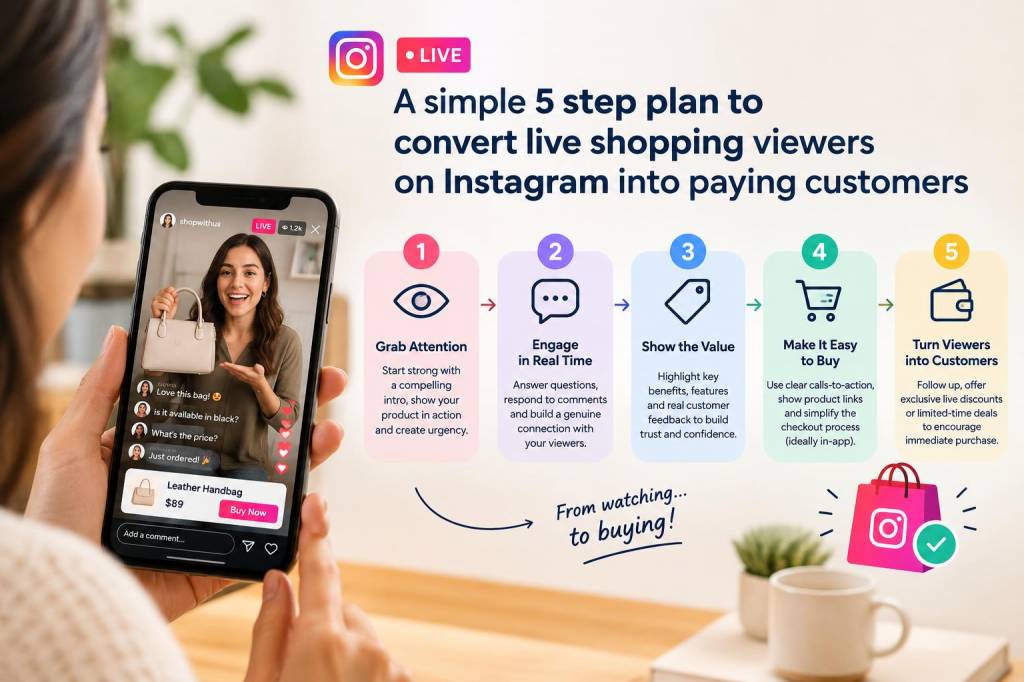
Live shopping on Instagram is one of those opportunities that looks simple on the surface and surprisingly slippery in practice. I’ve run and advised dozens of live sessions — from product drops for direct-to-consumer brands to creator-led showcases — and the gap between viewers and buyers usually comes down to how you structure the experience. Below is a tight, practical 5-step plan I use to turn passive viewers into paying customers without sounding like a pushy host.
Get the right audience in the room (and know why they came)
Before you go live, make sure the people who show up actually want what you’re selling. You can’t convert everyone, but you can stack the deck.
Use targeted promos: Promote the live to your most engaged segments — customers who viewed product pages, people on a cart-abandonment list, or followers who consistently engage with product posts. I prefer sending a short Instagram DM or a Stories sequence with a clear reason to join (early access, exclusive discount, limited stock).Set expectations: In the promotional creative, say exactly what will happen — “15-minute demo, 3 product drops, 20% voucher for viewers only.” Clear expectations increase attendance and reduce drop-off.Pre-live hooks: Run a poll, question sticker or countdown in Stories. These not only boost discovery (Instagram loves interactive stickers) but give you a preview of what your audience cares about so you can tailor the livestream content.Design the live session like a funnel — not a webinar
Think of the live as the top of a mini-funnel: attract attention, create desire, remove friction, and close. Build the session in short segments that each have a specific conversion purpose.
Start with a fast hook (0–2 minutes): Lead with value. A live viewer’s attention is fragile, so open with the most compelling offer or demo — “we’ve got 50 units at 20% off today only.”Demonstrate quickly (2–8 minutes): Show the product in real-world use. I prefer “show, don’t tell” — lighting, close-ups, motion. If it’s apparel, show fit on real bodies; if it’s a kitchen gadget, make a quick recipe.Social proof & scarcity (8–12 minutes): Read live comments, call out real customer photos, and use inventory cues — “30 left” or timer-based urgency — to nudge action without pressure.Streamline the path to buy (12+ minutes): Offer multiple, short CTAs throughout, and spend time guiding viewers through the checkout mechanism so there’s no friction at the point of decision.Remove friction: make buying from Instagram trivial
Conversion fails mostly because the path to purchase is clunky. Instagram gives you features, but you need to map them to your checkout UX.
Use Instagram Shopping and product tags: When possible, tag products during the live so viewers can tap and see product details immediately.Pinned comment with link: Pin a comment that contains a short, memorable URL, or better, a deep link that opens the product page or a one-click checkout in your mobile site. I often use link shorteners with UTM parameters so I can track performance.Shoppable landing page: Redirect the live traffic to a mobile-first landing page optimized for single-product checkout. Remove extra navigation, keep one primary CTA, pre-fill discount codes, and support Apple Pay/Google Pay to minimize typing.Use a promo code smartly: Make the code short and spoken clearly (“FLASH20”) — also display it as text several times during the live and in the pinned comment.Turn viewers into buyers with real-time interaction
Live formats are unique because you can immediately answer objections. Make that your conversion engine.
Call-and-response CTAs: Ask viewers to type “BUY” or “YES” if they want the link, then drop the link in reply. This not only captures intent but pushes the algorithm to show your live to more people because of engagement.Objection handling on the fly: Monitor comments actively. When someone asks about sizing, shipping or returns, answer publicly — those responses help other undecided viewers. I always have a checklist of three common objections and quick, honest replies ready.Use live demos to solve doubts: If a viewer asks about quality, zoom in on the material. If it’s a tech product, show the boot-up or a feature in action. Seeing resolves more anxiety than any promo line.Highlight real-time social proof: Read recent orders, show purchase confirmations (with permission), or invite a recent customer to pop into the comments. Authenticity wins.Measure, iterate and re-engage buyers immediately
After the live, the work isn’t done. You need to measure what moved the needle, and act fast to keep momentum.
Key metrics to track: peak viewers, average view time, comment rate, clicks on pinned link, conversion rate from live traffic, AOV (average order value), and returns/refunds. I track these with UTM-tagged links and simple spreadsheets or analytics tools like Google Analytics and Shopify reports.Segment buyers vs. non-buyers: Export lists right away. Send buyers a thank-you DM with shipping expectations and a cross-sell offer. For non-buyers who clicked but didn’t convert, run a tight retargeting sequence with dynamic product ads or Stories reminders.Ask for feedback: Send a short survey to buyers and a quick poll to those who attended but didn’t purchase. Ask one question: “What stopped you from buying today?” You’ll get the most actionable answers with minimal effort.Iterate the format: Test length (15 vs. 30 minutes), talent (host vs. influencer), pricing mechanics (discount vs. bundle), and CTA formats (QR code vs. pinned link). Change only one variable per live so you can learn what genuinely moves conversions.One last practical tip: build a repeatable checklist for every live. Mine covers pre-live promotion lists, tech checklist (sound, lighting, connection), pinned comment text, demo order of products, and a post-live action plan. It makes each session smoother and lets you focus on storytelling, not logistics.
Live shopping on Instagram is a mixture of theatre, sales and customer service. Treat each live like a micro-campaign: define the audience, structure the content to nudge decisions, remove friction, use interaction as conversion fuel, and measure like you mean it. Do that consistently and you’ll see viewers turn into real, paying customers.