I’ve written and reviewed more martech RFPs than I care to admit—and most of them are bloated, vague, and ignored by vendors. When you’re shopping for a best-of-breed tool that must sit under a strict budget (say, £5k/year), the RFP needs to be short, sharp and purpose-driven. A one-page RFP forces clarity: you get faster, more comparable responses and can shortlist tools that actually meet the business need without drowning in feature lists.
Why a one-page RFP works
Long RFPs are often written to protect the issuer more than to find the right product. They ask for everything and assume the vendor will fill in the gaps. A one-page brief does the opposite: it tells a vendor what matters, how you’ll judge success, and what constraints they must respect. Vendors that can’t answer clearly on a single page probably won’t be easy partners when you’re on a tight budget and timeline.
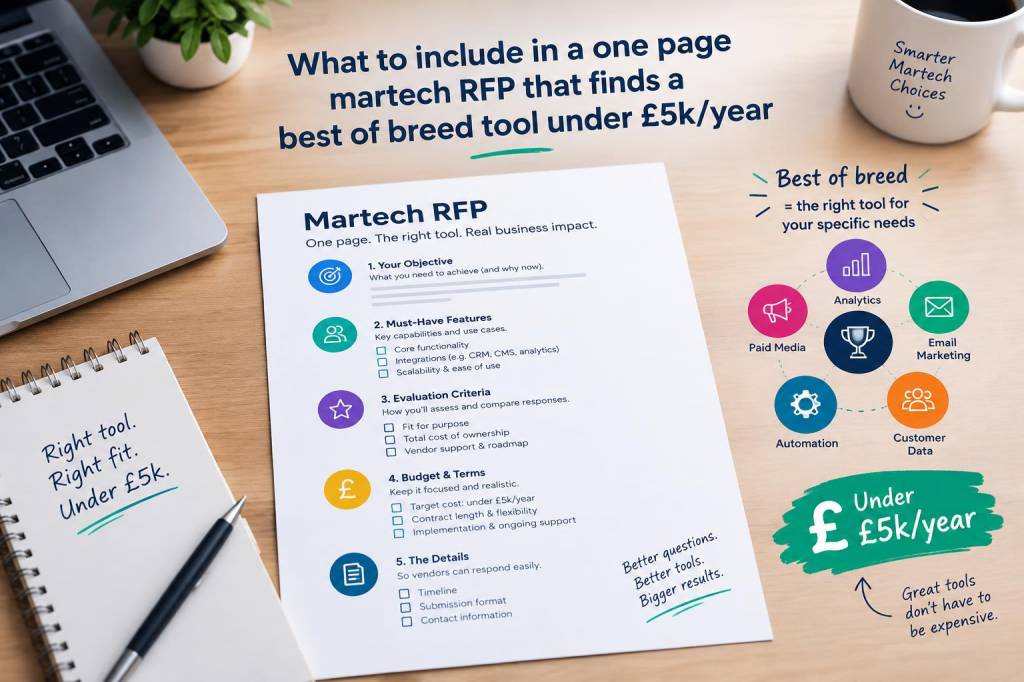
Core structure: what to put on that one page
Keep it scannable. I use 5 short blocks that fit easily on one printed page (or a single-screen email). Each block should be 1–2 lines where possible.
What vendors should answer (and how to score it)
For quick comparison I use a 100-point system split across five areas—each with a short, binary-friendly question set so vendors can answer succinctly:
| Area | Weight | Quick questions (yes/no / 1–2 lines) |
|---|---|---|
| Fit to use case | 35 | Does the product natively support the 2–3 core use cases? Examples of real customers using it this way? |
| Cost & terms | 20 | Can you deliver within £5k/year? Any per-seat, per-event, or module add-ons? |
| Implementation & time to value | 20 | Typical setup time for a team of our size (we’re X devs / X marketers). Self-serve docs or managed onboarding? |
| Integrations & API | 15 | Key connectors (e.g., Google Analytics, Shopify, HubSpot, Mailchimp)? Open API / webhooks? |
| Security, support & SLAs | 10 | Data residency, encryption, uptime SLA, support response time? |
Score each vendor and order by weighted total. The scoring model keeps vendors honest and makes trade-offs explicit: a cheap tool that lacks key integrations won’t win over a slightly pricier option that requires minimal dev time.
Technical and integration checklist (keep it minimal)
Under a strict budget, you can’t assume unlimited engineering time. I include a short checklist vendors must address in 1–2 lines each:
Security, compliance and data protection
Even for small budgets, you can't ignore security. Keep requirements tight and practical:
Pricing transparency: what to demand
Ask vendors to show the exact bill for a small realistic workload. I always require a small worked example in the RFP:
Vendors who hide pricing to force a sales call are often not a good fit when you must stay under a strict cap. If they won’t give ballpark numbers, deprioritise them.
Timeline and decision rules
Be explicit about timelines and what you expect after submission. A typical one-page timeline looks like this:
I’m blunt with vendors: “If you can’t demo within five business days, tell us now.” If they’re already stretched on timelines, they’ll be stretched when you need support.
Sample one-page RFP (copy/paste friendly)
| Company | [Your company name] |
| Context / Problem | We need a lightweight customer data platform to centralise web + mobile events for segmentation and simple activation into email and advertising channels. |
| Primary Use Cases | 1) Capture 5–10M events/year; 2) Build and sync behavioural segments to Mailchimp and Facebook ads; 3) Export CSVs for BI. |
| Must-have constraints | Budget <= £5k/year; EU/UK data residency; self-serve implementation with JS SDK; API access; no hidden per-event upcharges beyond example below. |
| Success Criteria | Deliver segments to Mailchimp within 1 hour of event; reduce manual CSV exports by 80%; total cost <= £5k/year. |
| Evaluation ask (one paragraph) | 1) Short product summary; 2) Top 3 relevant features; 3) Pricing worked example for 10M events/year; 4) Typical setup time; 5) One customer reference. |
| Deadline | [date, 5–7 business days] |
One-page RFPs simplify procurement conversations and surface vendors that are honest about suitability and pricing. In my experience, the best outcomes come from vendors who can be concise and practical—same values we should apply to martech selection when budgets are small and stakes are real.