I care a lot about trial-to-paid conversion because it is one of the clearest places where martech either proves its value or creates noise. In many SaaS teams, the trial starts off looking healthy, then users quietly disappear, and months later everyone is arguing about whether the lead source, onboarding email, product usage, or sales follow-up actually made a difference. In my experience, conversion rarely comes down to a single signal. It is usually a pattern of signals that appear early, often within the first few sessions, and those signals are only useful if I can track them cleanly enough to trust them.
What I look for before I trust any conversion signal
When I work through trial data, I start with a simple question: is this signal showing intent, activation, habit, or purchase readiness? That matters because a trial user can be active without being serious, or serious without yet being active in the product. If I mix those states together, I end up rewarding the wrong behaviour.
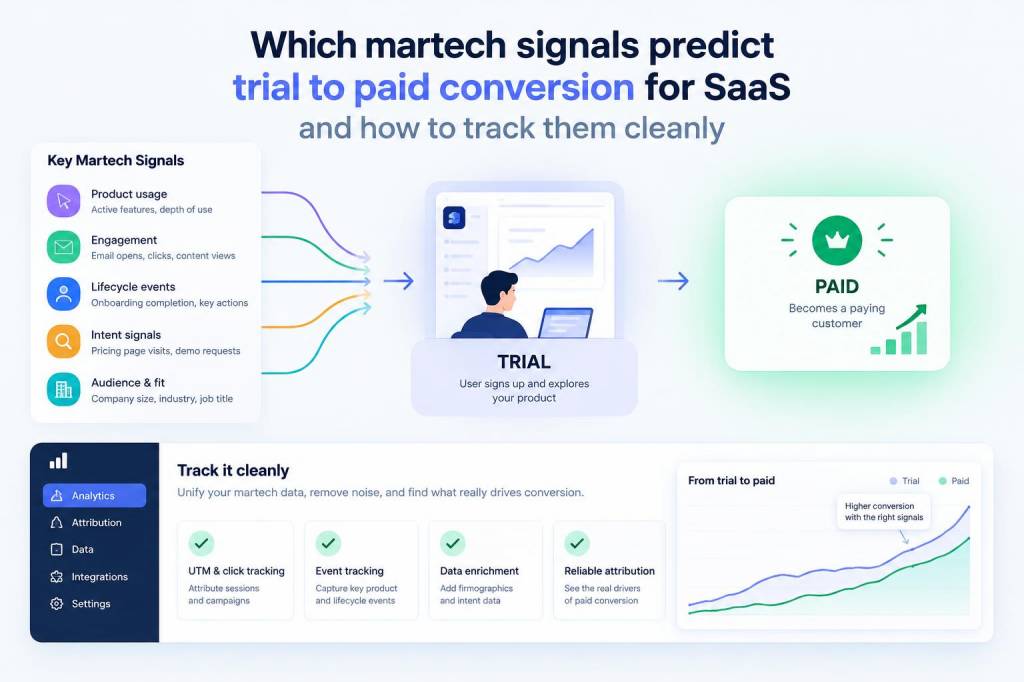
The signals I pay most attention to usually fall into four groups:
- Acquisition quality: source, campaign, keyword theme, referral path, and audience segment
- Activation behaviour: account setup, first value moment, feature discovery, and workflow completion
- Engagement depth: repeat sessions, return time, team invites, and feature breadth
- Buying intent: pricing page visits, plan comparison, billing setup, sales reply, and demo requests
I do not treat these as equal. Some are strong predictors, and some are merely convenient proxies. A pricing page visit can mean serious interest, but it can also mean confusion. A completed setup flow can mean intent, but it can also mean curiosity. The real job is to combine signals so that I can see whether a user is moving toward value, not just moving around the interface.
Signals that usually predict paid conversion
Over time, I have found a few signals that consistently show up before trial-to-paid conversion in SaaS, especially for products with a clear activation event.
Time to first value is one of the strongest. If a user reaches a meaningful outcome quickly, conversion odds usually improve. That value moment will look different depending on the product. For a project management tool, it may be creating the first project and inviting a teammate. For an analytics product, it may be connecting a data source and viewing a live dashboard. For a design tool, it may be exporting a first asset. I pay close attention to the minutes or hours between signup and that first value event.
Return frequency is another strong sign. One session tells me interest; multiple sessions tell me momentum. If someone comes back on day two and day three, I start to believe the product is entering their routine. I also look at spacing. A user who returns within 24 hours often behaves differently from one who returns after a week. Short gaps tend to suggest active evaluation or early habit formation.
Feature depth matters more than surface clicks. I want to know whether users are exploring one feature or many, and whether they are moving from broad curiosity to specific workflow use. In most products, the users who convert are not the ones who only skim the interface. They are the ones who make the software part of a real job to be done.
Invite or collaboration actions are especially powerful in team-based SaaS. If a trial user invites colleagues, shares access, or sets permissions, that is often a sign that the product has crossed from personal evaluation into organisational adoption. Once more than one person depends on a trial workspace, conversion tends to become less speculative and more operational.
Commercial intent events are obvious, but still useful when read properly. Visits to pricing, plan comparison, invoice settings, and billing pages can matter a lot, especially when they happen after a user has already found value. I never treat these as standalone proof, but they are often the final layer before purchase.
Signals I treat with caution
There are also signals that look useful but can mislead me if I rely on them too heavily. High page views, for example, do not always predict conversion. In some products, they can actually indicate confusion. The same is true for long session duration. A long session may mean deep engagement, or it may mean the user is lost.
I am also careful with email opens. They are easy to measure, but they are weak predictors unless they connect to product behaviour. If a user opens every onboarding email but never performs the key action in the app, I do not count that as progress. I want a clean line from message to action.
Another trap is overvaluing lead score models that are built on too many tiny events. I have seen scoring systems where every scroll, hover, and video play adds points. That may feel sophisticated, but it often creates a false sense of precision. A model is only as good as the business outcome it predicts. If the score cannot reliably separate future buyers from future drop-offs, I do not trust it.
How I track these signals cleanly
Clean tracking starts with one rule: every important event needs a clear business meaning. If I cannot explain why an event matters in one sentence, I probably should not track it. That keeps the event schema focused and prevents metric clutter.
I usually define events in a simple hierarchy:
- Identity events: signup, login, team creation, account verification
- Activation events: first project, first integration, first dashboard, first export, first workflow completion
- Engagement events: repeat use, feature adoption, team invites, notifications acted upon
- Commercial events: pricing view, upgrade click, billing started, payment completed, cancellation intent
Then I make sure each event has consistent properties. For example, if I track a first export, I want properties such as product plan, acquisition source, company size, role, device type, and timestamp. Without those properties, I lose the ability to compare cohorts properly.
I also prefer server-side tracking for the events that matter most. Client-side tracking can be fine for lightweight engagement data, but important lifecycle events should be recorded in a way that is less vulnerable to ad blockers, browser quirks, or page-load failures. If payment success or key activation is important, I want that captured from the backend whenever possible.
For tools, I have worked with combinations of Segment, RudderStack, Amplitude, Mixpanel, GA4, and CRM platforms like HubSpot or Salesforce. The exact stack matters less than the discipline behind it. A messy implementation in a premium stack is still messy. A simple stack with strict naming rules and ownership can outperform a bloated one.
What a clean measurement setup looks like in practice
When I design a tracking plan, I try to keep it close to the product journey. I map the user path from signup to activation to conversion, then I ask which moments are truly meaningful. I do not start with tools. I start with the behaviour I want to understand.
Here is a simple table I like to use internally when I think about trial conversion events:
| Signal | Meaning | Tracking note |
|---|---|---|
| First value event | User reaches meaningful outcome | Track on server side if possible |
| Repeat session within 24 to 72 hours | Momentum and evaluation progress | Use consistent timezone logic |
| Team invite | Product moving toward shared use | Capture inviter role and team size |
| Pricing page after activation | Purchase curiosity after value | Combine with prior product behaviour |
| Billing started | Strong commercial intent | Differentiate from abandoned checkout |
Clean tracking also means I am careful with attribution windows. If a user clicks an ad, signs up three days later, and converts two weeks later, I do not want every system claiming credit without context. I look at first-touch, last-touch, and product-touch behaviour together. In SaaS, product behaviour often explains more than channel alone.
Segmentation makes the signals more useful
I get much better insight when I segment trial users instead of averaging everyone together. A founder-led startup, a mid-market sales team, and an enterprise procurement cycle will not behave in the same way. The same signal can mean different things in each segment.
For example, a solo user who invites no one may still convert if the product is self-serve and low-friction. A team trial without invites, on the other hand, may be a warning sign. Similarly, a pricing page visit might be early curiosity in a small product, but a late-stage signal in a more complex platform.
I usually segment by:
- Company size
- Role or job function
- Acquisition source
- Use case
- Trial length
- Product category or package
This helps me avoid false generalisations. What predicts conversion for one cohort may be irrelevant for another.
What I do with the data once I trust it
Once the signals are clean, I use them to improve onboarding, lifecycle messaging, sales handoff, and product prioritisation. If a user reaches the first value moment quickly and then stalls, I may test a nudge that pushes them toward collaboration or deeper feature use. If many users visit pricing but do not convert, I want to know whether the issue is pricing clarity, packaging, missing trust cues, or a product gap.
I also like to build simple early-warning and early-success views for the team. Early-success cohorts help me see what converted users did in their first few days. Early-warning cohorts help me identify where drop-off starts. That way I am not just reporting conversion rate after the fact; I am identifying the behaviours that shape it.
In my view, the most useful martech is not the stack with the most dashboards. It is the stack that helps me see real behaviour, connect it to revenue, and act on it without guessing. When trial-to-paid conversion is measured cleanly, the product team learns what value looks like, marketing learns which audiences are serious, and growth teams can spend less time debating attribution and more time improving the actual user journey.